Cognition's New Chip Aims to Break Nvidia’s Stranglehold on AI
In a packed Hot Chips 2026 keynote, a secretive startup named Cognition Machines just unveiled the Synapse S1—a custom AI processor that could fundamentally rewrite the economics of large-scale artificial intelligence and end the GPU's reign.
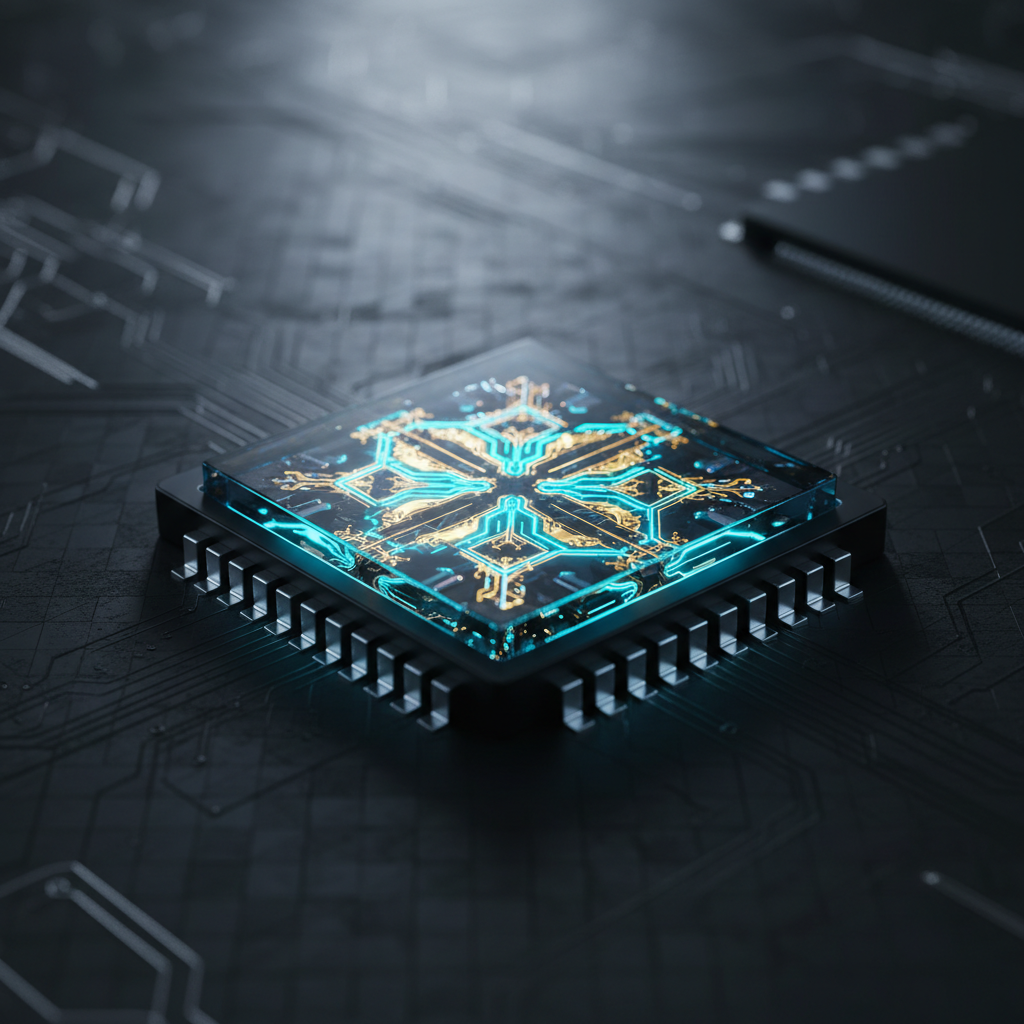
The Audacious Claim: A Generational Leap in Performance
For years, the AI industry has operated under a simple assumption: progress is spelled N-V-I-D-I-A. But at the Hot Chips 2026 symposium in Cupertino today, a relatively unknown startup, Cognition Machines, made a claim so audacious it sent immediate shockwaves through the sector. Their first product, the Synapse S1 Processor Unit (SPU), isn't just an incremental improvement. According to their benchmarks, it delivers a staggering 5x increase in large language model (LLM) inference performance and a 3x boost in training efficiency compared to Nvidia's brand-new, top-tier "Kelvin" K200, which only began shipping to hyperscalers last quarter. The S1 also reportedly eclipses AMD's latest Instinct MI450X, a chip that was itself seen as a credible challenger.
CEO Dr. Elara Vance, a veteran of both Google's TPU division and Apple's silicon design group, presented data showing the S1 sustaining unprecedented token-per-second-per-watt metrics on models like GPT-5 and Anthropic's Claude 4. “We didn’t try to build a better GPU; we asked what the ideal silicon for transformers would look like from first principles, and built that,” said Dr. Vance during her presentation, met with a mix of stunned silence and excited murmuring from the audience of silicon engineers and industry analysts.
A Fundamentally Different Architecture
The secret to the S1's alleged performance isn't just more transistors or a smaller process node (though it does use TSMC's latest 2nm process). Instead, it’s a wholesale rejection of the Graphics Processing Unit (GPU) architecture that has dominated AI. GPUs are masters of general-purpose parallel computation, an attribute inherited from their graphics rendering origins. Cognition Machines argues that this generality is now a bottleneck for the specific, predictable workloads of transformer-based AI models.
The Synapse S1 utilizes what the company calls a "Dataflow Streaming Architecture" (DSA). Think of it less like a massive grid of thousands of simple calculators (a GPU) and more like a purpose-built, reconfigurable assembly line for AI mathematics. In a GPU, data is constantly shuffled between memory and compute cores. In the S1's DSA, data flows in a continuous stream through specialized hardware units dedicated to specific operations of the transformer lifecycle: multi-head attention, feed-forward networks, and layer normalization.
The End of the Memory Bottleneck?
One of the S1's most significant innovations is its approach to memory. Instead of relying solely on massive, power-hungry pools of high-bandwidth memory (HBM) like GPUs, the S1 integrates a vast amount of ultra-fast SRAM directly adjacent to its compute units. This design dramatically reduces the energy and time wasted moving data, which is often the primary performance limiter in large-scale LLM inference. By pre-loading model weights into this distributed memory, the chip can process inference requests with minimal latency, a key factor for real-time applications like conversational AI and autonomous systems.
The Minds Behind the Machine
Cognition Machines is not your typical startup. Founded in 2023, it has remained in deep stealth mode, funded by a quiet $450 million Series A led by a consortium of sovereign wealth funds and specialized deep-tech VCs. Its founding team is a who's-who of silicon architecture. CEO Dr. Vance was a lead architect on Google's TPU v4 and v5, while her co-founder and CTO, Kenji Tanaka, was a distinguished engineer in Apple's M-series GPU team. This pedigree gives their claims a weight that a lesser-known team could never command.
At some point, the technical debt of a general-purpose architecture becomes too great. The physics of data movement will always trump raw teraflops. The S1 is built on that truth.
Their strategy appears to be a direct echo of how Apple built its own silicon advantage: by co-designing hardware and software for a very specific task. Cognition has developed its own compiler and software stack, called "NeuronFlow," designed to translate models written in common frameworks like PyTorch and JAX directly onto the S1's unique dataflow hardware. This is a critical piece of the puzzle, as hardware is useless without an accessible software ecosystem.
Nvidia's Moat is More Than Just Silicon
While the S1's performance figures are impressive, dethroning Nvidia is a monumental task. The company's dominance rests on a three-legged stool: best-in-class hardware, the indispensable CUDA software platform, and an unrivaled developer ecosystem built over 15 years. Every major AI framework, research paper, and data scientist is fluent in CUDA. To succeed, Cognition Machines must not only deliver superior hardware but also provide a software experience so seamless and powerful that it justifies the cost of switching.
“An amazing chip is step one of a ten-step journey,” commented Linus Cheng, a semiconductor analyst at Tech-Altimeter Group. “Nvidia won’t be standing still. They have the resources to react, the customer relationships, and a software lock-in that is arguably the strongest in tech history. Cognition needs flawless execution on manufacturing, software, and sales to even make a dent.” Nvidia's stock dipped 4% in after-hours trading following the announcement, a minor tremor but a clear sign that Wall Street is taking the threat seriously.
A Ripple Effect Across the Cloud
The biggest potential customers for the Synapse S1 are the hyperscale cloud providers: Amazon Web Services, Microsoft Azure, and Google Cloud. These companies spend tens of billions of dollars a year on Nvidia GPUs and are desperate for a viable second source to increase their bargaining power and reduce costs. If Cognition's claims of 5x inference performance at a competitive price point hold true, adopting the S1 would be a strategic imperative, potentially saving them billions on both capital expenditure and operational energy costs.
Smaller, AI-focused cloud players like CoreWeave and Lambda Labs could also be kingmakers. By being the first to offer S1-powered instances, they could attract a significant portion of the AI development market looking for the best possible performance-per-dollar, leapfrogging the slower-moving giants.
The Long Road From Hot Chips to Hyperscale
The Synapse S1 is currently sampling with a handful of undisclosed "strategic partners." General availability for cloud providers and large enterprises is slated for Q2 2027. The path from a stunning demo at Hot Chips to mass production and deployment is fraught with peril. Manufacturing a brand-new architecture at scale with TSMC is a complex dance, and any yield issues could spell disaster. Furthermore, the NeuronFlow software stack must prove itself to be robust, easy to use, and free of the subtle bugs that can plague new compilers.
Still, today's announcement marks the most significant architectural challenge to GPU dominance in a decade. It signals a new phase in the AI arms race, where bespoke, specialized hardware may finally break the de facto monoculture. Whether the Synapse S1 becomes the foundation of the next era of AI or a historical footnote like so many other "Nvidia killers" depends on whether Cognition Machines can turn its architectural brilliance into a real-world revolution.
Frequently asked questions
Is the Synapse S1 a type of GPU?+
No, it is fundamentally different. The S1 is a custom processor, which Cognition Machines calls an SPU (Synapse Processing Unit). It uses a 'Dataflow Streaming Architecture' specifically designed for transformer AI models, unlike the general-purpose parallel architecture of a GPU. This specialization is the source of its claimed performance advantage. It cannot be used for tasks like gaming or graphics rendering.
When can developers actually start using the S1 chip?+
The Synapse S1 is currently sampling with a few large, strategic partners. Cognition Machines has announced that broader availability for cloud service providers and major enterprises is planned for the second quarter of 2027. It will likely first appear in specialized cloud instances before any potential for on-premise hardware becomes available to the general public.
How is this different from Google's TPUs or other custom AI chips?+
While Google's Tensor Processing Units (TPUs) are also custom ASICs for AI, they were designed for a broader range of neural networks. Cognition's S1 is even more specialized, focusing almost exclusively on the transformer architecture that powers modern LLMs. The S1's 'Dataflow Streaming' design is a distinct approach aimed at minimizing data movement, which Cognition claims gives it an edge over both TPUs and GPUs on the newest generation of AI models.
How much will the Synapse S1 cost?+
Cognition Machines has not announced public pricing for the S1. This type of hardware is typically sold directly to hyperscale data centers and large enterprises, not individual consumers. Pricing is usually negotiated based on volume. However, the company's value proposition is based on a superior total cost of ownership (TCO), suggesting its price-per-performance ratio will be significantly better than current GPU offerings.
Will this chip affect the graphics card in my gaming PC?+
No, not directly. The Synapse S1 is a dedicated data center AI accelerator and has no graphics rendering capabilities. It won't be in consumer gaming cards. However, if it successfully eases the demand for high-end Nvidia and AMD GPUs from the AI industry, it could indirectly lead to better availability and potentially more competitive pricing for consumer graphics cards in the long term.
Liked this story?
Share it with a colleague, or explore more in the Artificial Intelligence section.
More stories

AWS Debuts Graviton5 Pro: A 'Processing-in-Memory' Chip to Break Nvidia's Stranglehold
Amazon Web Services just revealed Project Cerebrum: a new "processing-in-memory" chip called Graviton5 Pro. This radical design, available in new P1 instances, directly targets the memory bottlenecks that plague large AI models—and Nvidia's market dominance.

The Empire Strikes Back: DOJ Sues Coherence AI in Landmark Antitrust Case
The Justice Department just fired the opening salvo in what could be the defining antitrust battle of the decade, suing AI juggernaut Coherence AI. At stake: the very architecture of the AI economy and who gets to build its future.

Cerebrum’s New ‘LPU’ Chip Aims to End NVIDIA’s AI Inference Stranglehold
After years in stealth, Cerebrum Systems just launched the Synapse-1, a specialized "Language Processing Unit." The chip promises to slash the cost of running large language models, posing the most credible threat yet to NVIDIA’s data center empire.