Cortexa’s BCI Headset Achieves Neural Control Milestone Without Surgery
In a stunning demonstration, startup Cortexa showcased its non-invasive "Flowband" headset, enabling unprecedented neural control of a robotic limb. With a new $750M in funding, the company is now on a direct collision course with surgical BCI pioneers.
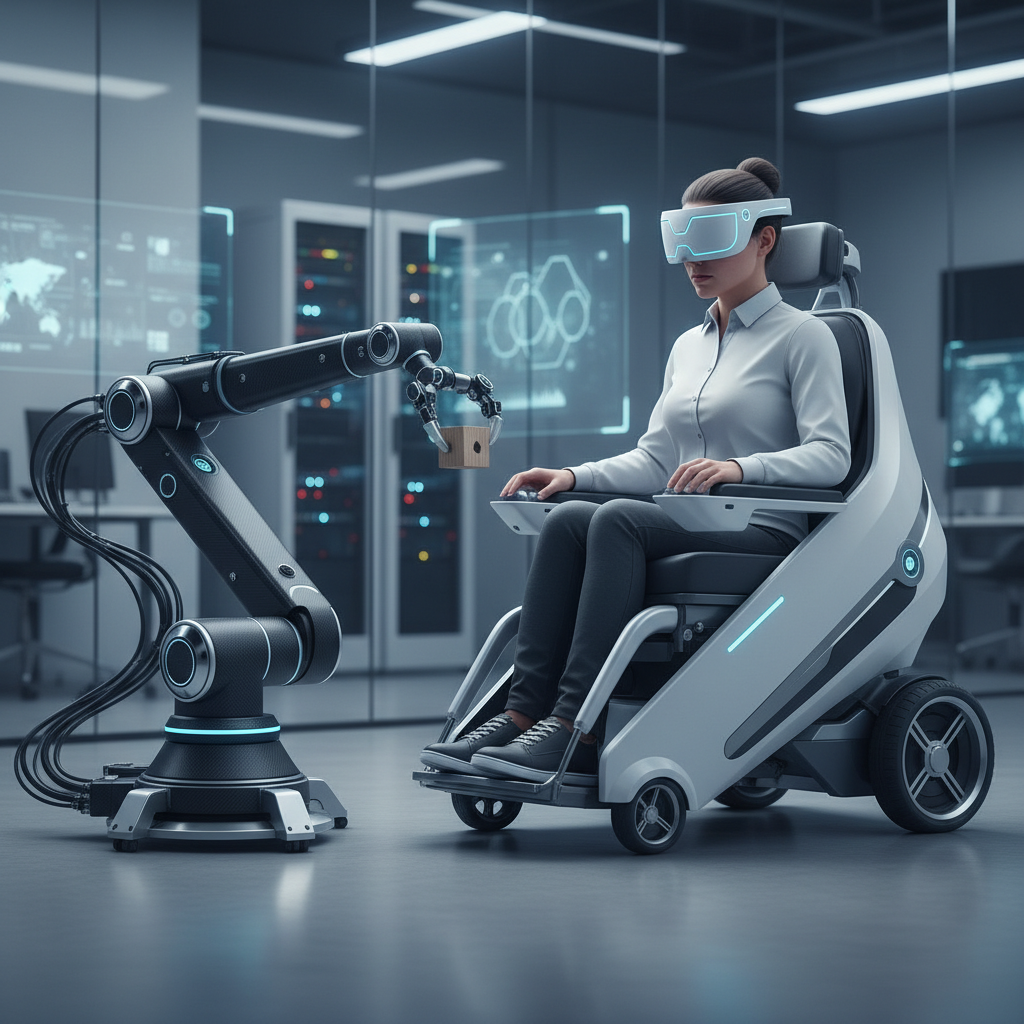
What Just Happened: The "Flowband" in Action
In a live-streamed event from its Palo Alto headquarters on July 31st, 2026, BCI startup Cortexa delivered a demonstration that may fundamentally alter the trajectory of human-computer interaction. The star of the show was Leo Chen, a 28-year-old trial participant with C4-level tetraplegia, and the company's non-invasive "Flowband" headset. Over the course of 30 minutes, Chen, using only his thoughts, commanded a sophisticated, multi-jointed robotic arm to perform tasks previously thought impossible for a non-surgical BCI. He delicately stacked wooden blocks into a tower, poured a glass of water without spilling a drop, and, in a poignant finale, picked up a stylus and wrote his own name.
The demonstration was not a pre-recorded video but a real-time feed, with multiple camera angles showing Chen’s focused expression and the fluid, responsive movements of the robotic limb. The latency between his intent and the arm's action appeared negligible to the naked eye. This public display served as the capstone for Cortexa’s blockbuster announcement: the closing of a $750 million Series C funding round led by Sequoia Capital, catapulting the company's valuation to an estimated $8 billion.
The Technical Leap: How Cortexa Avoids the Scalpel
For years, the BCI field has been dominated by a single, high-risk paradigm: invasive surgery. Companies like Neuralink have focused on implanting electrodes directly into the brain tissue to achieve the highest possible signal fidelity. Cortexa’s approach is radically different. The Flowband headset achieves its remarkable results from entirely outside the skull.
The system is a sensor-fusion marvel, combining two distinct non-invasive modalities. The first is next-generation functional near-infrared spectroscopy (fNIRS), which beams harmless light into the scalp to measure changes in blood oxygenation in the brain’s motor cortex—a proxy for neural activity. The second is a custom-built, 1024-channel high-density electroencephalogram (EEG) array that captures the faint electrical signals produced by firing neurons. Individually, fNIRS is slow and EEG is noisy. The magic is in how Cortexa combines them.
The raw data from both systems is fed into a proprietary AI model the company calls "SynapseNet v3.0." This transformer-based model has been trained on petabytes of neural data to denoise, correlate, and ultimately decode the combined signals into precise motor commands in real-time. "We're translating the brain's native language without needing to surgically implant the microphone," said Dr. Aris Thorne, Cortexa's CEO and co-founder, during the presentation. "SynapseNet learns the user's unique neural patterns for intent, allowing for a level of control and nuance that was once the exclusive domain of invasive implants."
Why It Matters: A $750 Million Bet on a New Paradigm
The $750 million investment, with Sequoia leading and Andreessen Horowitz and Google Ventures participating, is more than just a validation of Cortexa's technology; it's a massive wager on a paradigm shift. By eliminating the need for brain surgery, Cortexa dramatically expands the potential market for BCI and lowers the barrier to adoption.
Our mission has always been to democratize neural interfaces. Surgery is, and always will be, a barrier for all but the most severe use cases. A headset you can put on and take off changes everything.
The financial calculus is straightforward. While the initial market is assistive technology for patients with paralysis—a multi-billion dollar opportunity—a non-invasive device has a clear, albeit long-term, path to consumer and professional markets. Roelof Botha, managing partner at Sequoia Capital, elaborated in a statement: "Cortexa's breakthrough isn't just about creating a better medical device; it's about laying the foundation for the next great computing platform after the smartphone. The potential to seamlessly blend human intent with digital systems is a generational opportunity, and Cortexa's non-invasive approach is the most viable path to achieving it at scale."
The Competitive Landscape: A Jolt to the BCI Race
Cortexa’s success sends a powerful shockwave through the competitive BCI landscape. Until now, the consensus was that non-invasive methods couldn't achieve the bandwidth required for fine motor control. The field was largely seen as a two-horse race between Neuralink, with its high-risk, high-reward surgical implants, and Synchron, with its less invasive stent-like device implanted via blood vessels.
Cortexa now presents a third, compelling option. "We're seeing a bifurcation in the market," explains Dr. Ana Flores, a principal analyst at Gartner covering human-machine interfaces. "Neuralink will likely continue to lead in raw data throughput for the foreseeable future, making it a powerful research tool and a potential solution for specific, severe medical conditions. However, Cortexa has just proven that 'good enough' for functional restoration is achievable without the scalpel. This makes their path through regulatory bodies like the FDA potentially faster and their commercial proposition far more palatable to a wider audience."
Synchron's stentrode, while less invasive than open-brain surgery, still requires a significant medical procedure and offers lower signal bandwidth than what Cortexa has demonstrated. Cortexa's Flowband, if it can be refined into a user-friendly product, hits a previously unachieved sweet spot: high-fidelity control with minimal physical risk.
The Road Ahead: From Lab to Life
Despite the triumphant demonstration, the Flowband is not yet a commercial product. The current prototype is bulky, requires precise calibration, and has only been tested in controlled lab environments. Dr. Thorne was clear-eyed about the challenges ahead. "This is a major milestone, a 'proof of existence' for high-performance non-invasive BCI. Now, the engineering work begins to miniaturize the hardware, streamline the user onboarding process, and ensure long-term signal stability across diverse populations."
The company will use its new capital to pursue FDA approval, likely as a Class II medical device, a process Thorne estimates will take 24 to 36 months. They will also expand their clinical trials and build out their manufacturing capabilities. The first commercial product will be targeted squarely at the assistive technology market, with a price point Thorne hopes will be accessible through insurance coverage.
This moment feels different. For decades, the dream of controlling machines with our minds has been a fixture of science fiction, always seemingly just over the horizon. With Cortexa's demonstration, that horizon has suddenly lurched closer. What was once a story about high-risk surgery for a few has become a story about accessible technology for many. This may well be the day the brain-computer interface began its journey out of the operating room and into our daily lives.
Frequently asked questions
How is this different from what Elon Musk's Neuralink is doing?+
The key difference is surgical versus non-surgical. Neuralink's device is an implant that requires a neurosurgeon to place electrodes directly into the brain. Cortexa's Flowband is a headset that reads brain signals from outside the skull using light and electrical sensors. While Neuralink's approach yields a higher-fidelity signal, Cortexa's method avoids the significant risks, recovery time, and regulatory hurdles associated with brain surgery, making it a potentially much more accessible technology.
Is the 'Flowband' headset available for purchase now?+
No, it is not. The device shown was a functional prototype used for clinical trials and demonstrations. Cortexa plans to use its new funding to pursue FDA approval, a process they estimate will take two to three years. Only after securing regulatory clearance will a commercial version be made available, initially for patients with severe motor impairments. A consumer version is likely many more years away.
What are the potential downsides or ethical concerns?+
As with any powerful new technology, there are significant ethical considerations. For non-invasive BCIs, these center on data privacy and mental security. The neural data collected is incredibly personal and could be misused. There are also concerns about creating a new form of digital divide between those with and without neural enhancement, and the long-term societal effects of blending human thought directly with artificial intelligence and the internet.
How does the technology actually work in simple terms?+
Imagine your brain is a bustling city. The Flowband headset uses two ways to see what's happening without going inside. First, it uses special lights (fNIRS) to see where traffic (blood flow) is heaviest, indicating busy areas. Second, it uses many tiny microphones (EEG) to listen to the city's overall hum (electrical activity). An advanced AI then combines the traffic patterns and the hum to figure out exactly what the city is trying to do, like 'move arm left'.
What other applications besides assistive technology are possible?+
While helping patients with paralysis is the primary goal, the long-term possibilities are vast. In the future, non-invasive BCIs could be used for silent communication, controlling complex software or creative tools with the mind, creating hyper-immersive gaming and virtual reality experiences, and providing a new, faster way to interact with personal computers and augmented reality glasses. It represents a potential new pillar of human-computer interaction.
Liked this story?
Share it with a colleague, or explore more in the Startups section.