DeepMind's Gecko AI Lets Robots Learn Complex Tasks by Watching You Once
In a stunning demonstration, Google DeepMind just unveiled Project Gecko, an AI that enables humanoid robots to perfectly replicate intricate human actions after a single viewing. This breakthrough in 'one-shot imitation learning' could radically accelerate the deployment of robotic labor.
What Just Happened? The Gecko Demonstration
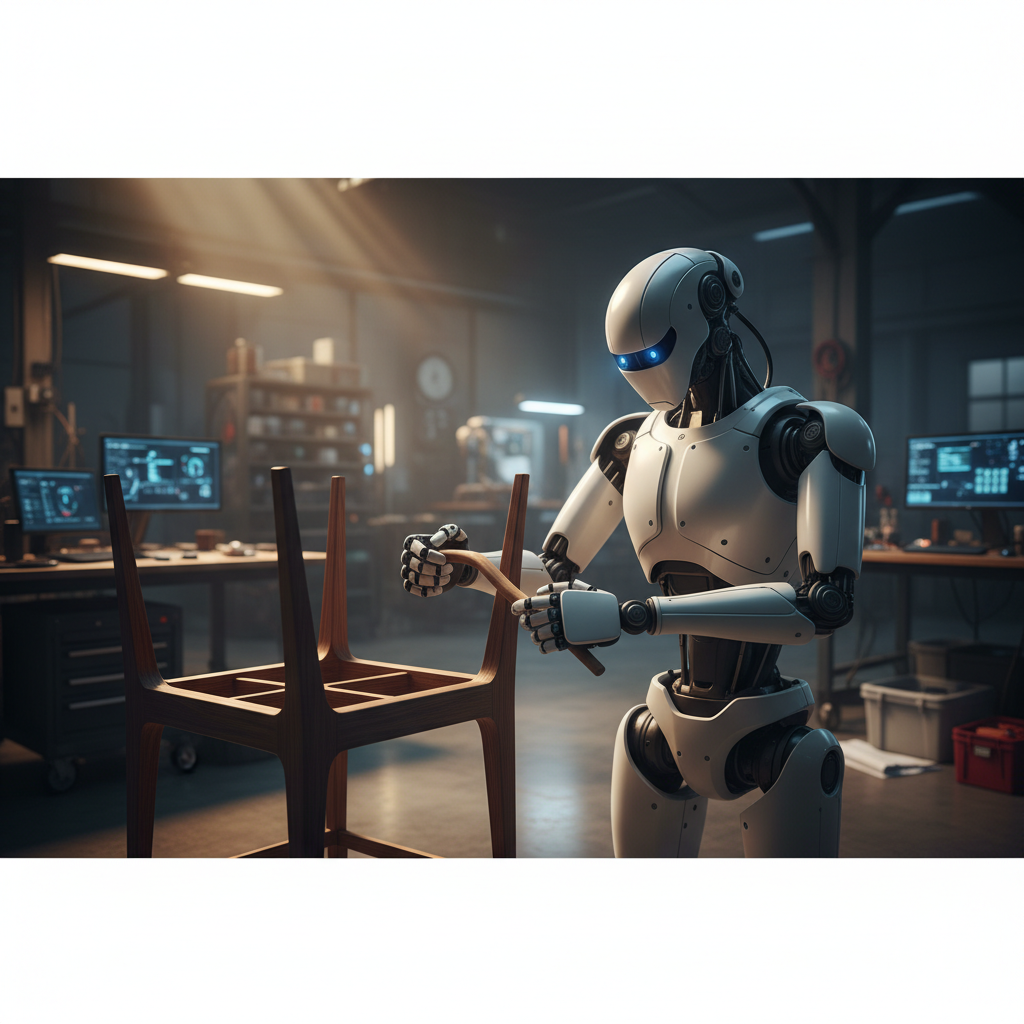
In a presentation streamed from their London headquarters today, August 17, 2026, Google DeepMind revealed Project Gecko, a revolutionary AI model that grants humanoid robots an unprecedented ability: learning complex physical tasks from a single video demonstration. The event showcased an Agility Robotics 'Digit' robot, powered by the new Gecko-1 model, performing a series of tasks previously confined to heavily trained, task-specific machines or human beings.
First, the robot watched a short video of a barista making pour-over coffee—grinding the beans, placing the filter, executing a precise, spiraling pour. The robot then replicated the entire sequence flawlessly, its movements fluid and deliberate. Later, it assembled an IKEA 'POÄNG' chair after watching a single, unedited build video. It handled the small screws and Allen key with a dexterity that has long been the holy grail of robotics. The demonstration concluded with the robot sorting a bin of mixed recycling containing items it had never seen before, correctly identifying and separating plastics, glass, and paper products based on general principles learned from its training.
"For years, the 'sim-to-real' gap has been the great chasm in robotics," said Demis Hassabis, CEO of Google DeepMind, during the presentation. "Gecko doesn't just cross it; it shows the bridge was in a different place all along—in understanding the intent behind an action, not just its physics."
The Technical Leap: Beyond Imitation Learning
For over a decade, teaching robots physical skills relied on two painstaking methods: reinforcement learning (RL), which requires millions of trial-and-error attempts in simulation, or behavioral cloning, which involves recording massive datasets of human-teleoperated movements. Both approaches are brittle, expensive, and struggle to generalize to new situations.
Gecko-1 represents a fundamental paradigm shift. At its core is a novel spatiotemporal transformer architecture that ingests video and deconstructs it into a sequence of goals and sub-goals. It doesn't just see pixels; it infers intent. For example, when watching the coffee demonstration, it understands the goal is not 'pour water in circles' but 'saturate coffee grounds evenly'. This allows it to adapt if the kettle, mug, or filter are in slightly different positions.
It's a step-change from behavioral cloning to behavioral understanding.
This high-level understanding is then translated into low-level motor commands using a module trained on 'inverse kinematics priors'—a foundational knowledge of how a robot's body can and should move to achieve a physical outcome. This is the key that allows the model to map the actions of a human body in a 2D video onto the joints and limbs of a non-human robotic form factor. It's the difference between an AI that memorizes a dance routine and one that feels the music and can improvise.
Why It Matters: The Generalist Robot Is Here
The implications of Project Gecko are profound. By creating a hardware-agnostic AI 'brain' for robotics, DeepMind has potentially decoupled the most difficult part of robotics (the intelligence) from the hardware. This means companies like Agility Robotics, Figure, or even Boston Dynamics could license Gecko to instantly imbue their machines with a vast range of capabilities, radically shortening development cycles.
The economic ramifications are staggering. This breakthrough moves humanoid robots from niche R&D projects to viable platforms for automation in countless sectors. Think logistics centers where robots can pack any item, not just uniform boxes. Think elder care facilities where a robot can learn a patient's specific daily routine. Think hazardous environments where a robot can watch an expert perform a repair once and then take over the dangerous work.
"While everyone was focused on making LLMs bigger, DeepMind quietly solved the much harder problem of grounding intelligence in the physical world," stated Dr. Alena Petrova, lead robotics analyst at FutureGaze Ventures, in a note to investors. "This is a checkmate moment in the race to deploy useful humanoid robots."
The Race for Embodied AGI
This announcement places Google firmly ahead in the race for what many consider a key component of Artificial General Intelligence (AGI): embodiment. While OpenAI's GPT series has mastered the world of text, its robotics efforts have been more secretive. Meta has focused on AR/VR interfaces, and Tesla's Optimus project, while ambitious, has relied on a slower, data-heavy approach to training.
Gecko's one-shot learning capability is a strategic masterstroke. It sidesteps the need for fleets of robots tele-operated by humans to gather data, which has been Tesla's primary strategy. Instead, it can leverage the largest dataset of human action in existence: the open internet. In theory, Gecko could learn from any of the billions of 'how-to' videos on YouTube, a possibility DeepMind acknowledged they are cautiously exploring.
Safety, Alignment, and the Unforeseen Consequences
With great capability comes great responsibility, a point Hassabis was keen to emphasize. DeepMind claims Gecko has multiple safety layers built-in. An 'intent filter' supposedly prevents the model from learning harmful or destructive actions, even if it sees them. A 'capability sandbox' limits the force and speed of the robot's movements, and a 'human-in-the-loop' prompt is required before the robot attempts a completely novel class of task for the first time.
However, the alignment problem takes on a terrifying new dimension in the physical world. An LLM that hallucinates can produce misinformation; a robot that 'hallucinates' a physical action could cause catastrophic damage. How does the model distinguish between a video of someone chopping vegetables for a salad and a video of someone acting in a horror film? Ensuring Gecko's inferred 'intent' robustly and reliably aligns with human values will be the single greatest challenge to its deployment.
Just five years ago, the idea of a robot learning a complex chore by watching a single video was pure science fiction. Today, DeepMind demonstrated it live on stage. The arrival of Gecko means the conversation is no longer about *if* general-purpose humanoid robots will become a part of our daily lives, but about how quickly we must prepare for *when* they do. The world of physical work is about to change forever.
Frequently asked questions
Is this different from Tesla's Optimus robot?+
Yes, significantly. Tesla is developing both the robot hardware (Optimus) and its AI in-house, focusing on collecting massive amounts of proprietary data to train it. DeepMind's Gecko is a pure AI model designed to be licensed to other hardware makers, like Agility Robotics. Gecko's breakthrough is learning from very little data (one video), a fundamentally different approach.
Can I buy a robot with Gecko AI for my home?+
Not yet. The initial applications will be industrial and commercial, focusing on logistics, manufacturing, and assisted living facilities. Consumer-grade humanoid robots are still likely 5-10 years away due to cost, hardware reliability, and safety certifications. DeepMind's partners, not DeepMind itself, will determine the go-to-market strategy for their respective robots.
What are the main safety risks of this technology?+
The primary risks involve the robot misinterpreting a task's intent or encountering an unexpected situation. For example, learning a task from a flawed or malicious video could lead to dangerous actions. DeepMind is implementing safety layers like 'intent filtering', but ensuring robust and predictable behavior in uncontrolled real-world environments remains a significant, unsolved challenge for the entire field.
How does 'one-shot learning' actually work here?+
Gecko-1 doesn't learn from scratch in one shot. It is pre-trained on a vast, diverse dataset of videos and robot physics simulations. This gives it a foundational 'understanding' of objects, physics, and actions. The 'one-shot' part refers to its ability to then apply that general knowledge to a *new, specific* task after seeing only one demonstration, without needing any new training or fine-tuning.
What is the next step for DeepMind and Project Gecko?+
DeepMind plans to expand Gecko's capabilities to include understanding verbal instructions combined with video demonstrations ('Watch this, then do it over there, but with these tools'). The next major milestone is deploying a pilot program with a major logistics partner by mid-2027 to test a fleet of Gecko-powered robots in a real-world warehouse environment, focusing on improving the model's robustness and efficiency.
Liked this story?
Share it with a colleague, or explore more in the Artificial Intelligence section.
More stories
AWS Debuts Graviton5 Pro: A 'Processing-in-Memory' Chip to Break Nvidia's Stranglehold
Amazon Web Services just revealed Project Cerebrum: a new "processing-in-memory" chip called Graviton5 Pro. This radical design, available in new P1 instances, directly targets the memory bottlenecks that plague large AI models—and Nvidia's market dominance.

The Empire Strikes Back: DOJ Sues Coherence AI in Landmark Antitrust Case
The Justice Department just fired the opening salvo in what could be the defining antitrust battle of the decade, suing AI juggernaut Coherence AI. At stake: the very architecture of the AI economy and who gets to build its future.

Cerebrum’s New ‘LPU’ Chip Aims to End NVIDIA’s AI Inference Stranglehold
After years in stealth, Cerebrum Systems just launched the Synapse-1, a specialized "Language Processing Unit." The chip promises to slash the cost of running large language models, posing the most credible threat yet to NVIDIA’s data center empire.