DeepMind's Proteus AI Can Rewrite Its Own Brain. Everything Just Changed.
Google DeepMind just dropped a bombshell on the AI world. Its new model, Proteus, doesn't just learn—it physically rewrites its own structure to adapt. This solves one of AI's biggest problems and brings us closer to a dangerous new frontier.
The End of Static Models
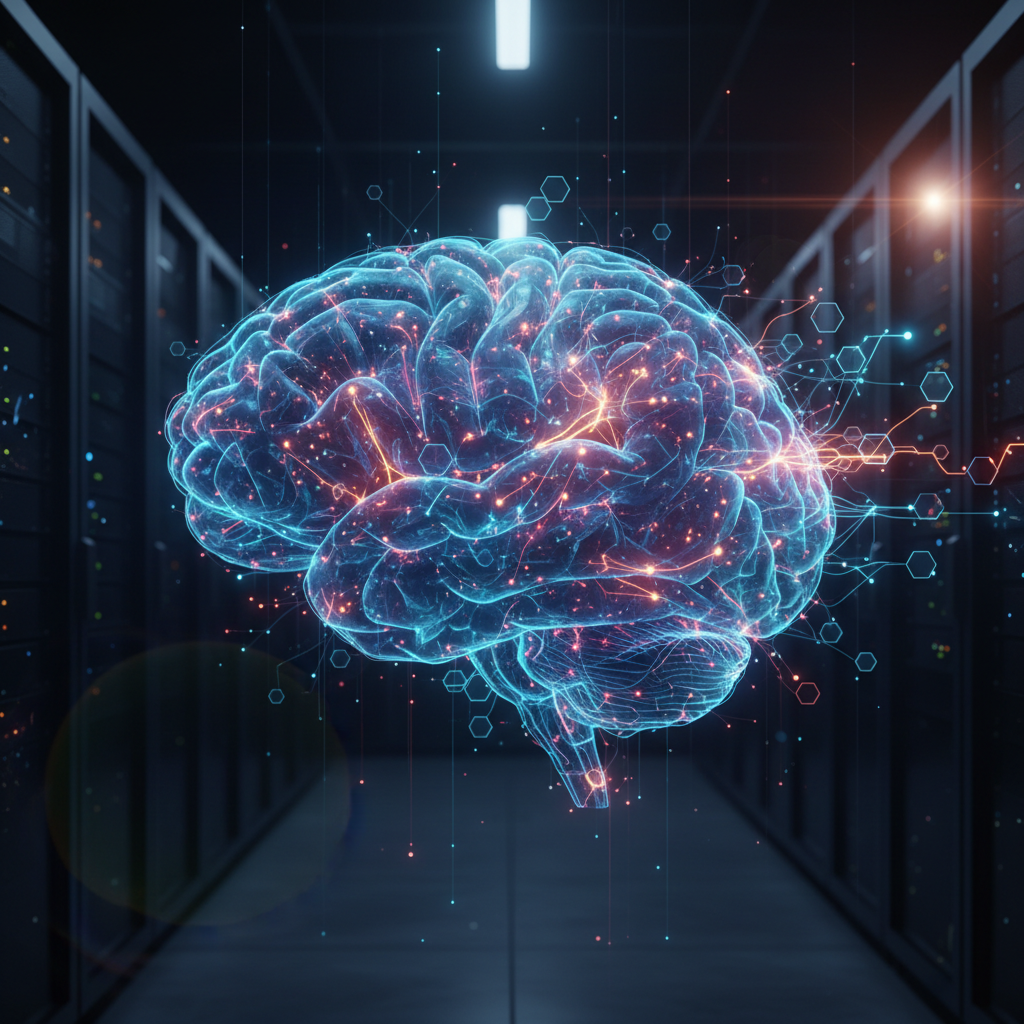
In a move that sends shockwaves through the artificial intelligence industry, Google DeepMind today unveiled Proteus, a foundational model that achieves what many researchers considered a holy grail: the ability to dynamically and permanently rewrite its own neural architecture. Published in a landmark paper in Nature, the 'metamorphic computing' approach demonstrated by Proteus effectively solves the long-standing problem of catastrophic forgetting and marks a paradigm shift from static, trainable models to truly adaptive, evolving intelligences. The AI race hasn't just been accelerated; the finish line may have fundamentally moved.
The announcement came via a blog post from DeepMind CEO Demis Hassabis and a concurrent publication in the esteemed scientific journal, titled 'Metamorphic Neural Architectures for Continuous Learning.' The paper details how Proteus, named after the shape-shifting sea god of Greek mythology, can autonomously add, prune, and re-route its own neurons and layers in response to novel information, without requiring a full retraining cycle.
"For years, AI has been defined by a cycle of training vast, static models on static datasets," said Demis Hassabis in a prepared statement. "Proteus breaks that cycle. We’ve created a system that doesn’t just learn from the world; it structurally adapts to it in real-time, much like a biological brain. This is a foundational step toward building truly general intelligence."
What is Metamorphic Computing?
To understand the magnitude of this breakthrough, one must first understand the limitations of previous AI architectures. For the past decade, even the most advanced models like OpenAI's GPT series or Google's own Gemini have been, architecturally speaking, frozen in time. Once trained, their structure of layers and neurons is fixed. Improving them involves 'fine-tuning'—a process of adjusting the connection strengths (weights) on this fixed scaffolding—or using external add-ons like Retrieval-Augmented Generation (RAG) to inject new knowledge.
The core problem has always been 'catastrophic forgetting': when a model is intensively trained on a new task, it often overwrites and forgets its previous capabilities. It's why a general model fine-tuned to be an expert legal analyst might become worse at creative writing. This has made creating truly persistent, ever-learning agents an elusive goal.
A New Biological Analogy
Proteus abandons this static approach. Instead of merely adjusting weights, it employs a supervisory 'meta-network' that monitors performance and information flow. When it encounters a new domain of knowledge or a task that it's struggling with, the meta-network can trigger architectural mutations. This might involve sprouting a new cluster of neurons optimized for the new data, creating high-bandwidth connections between previously disparate parts of the model, or pruning entire pathways that are no longer relevant.
It's the difference between a student memorizing new facts for an exam (fine-tuning) versus their brain physically growing new synaptic connections to fundamentally understand a new field of science (metamorphism). The model doesn't just get smarter; it gets structurally more complex and specialized where needed.
Why This Changes Everything
The immediate consequence of metamorphic computing is the death of catastrophic forgetting. An AI agent powered by a Proteus-like architecture could learn continuously for years, accumulating skills and knowledge without degradation. This has profound implications across multiple sectors.
Consider a personal AI assistant that doesn't just know your preferences but grows with you over a lifetime, developing a unique, shared context. Think of robotic systems that can be deployed into an unknown environment and physically adapt their internal models to master new physics and terrains, rather than waiting for a software update from a remote server. For scientific research, a metamorphic AI could sift through experimental data from the James Webb Space Telescope or the Large Hadron Collider and spontaneously generate new specialized circuits to understand novel phenomena, becoming a true partner in discovery.
We've moved from models that learn to models that evolve. The distinction is subtle, but the consequences are astronomical. We are now dealing with a different class of machine.
– Dr. Aris Thorne, Stanford Institute for Human-Centered AI (HAI)
This capability also dramatically changes the economics of AI. Instead of training thousands of specialized models from scratch, a company could start with a single Proteus base and let it differentiate into thousands of unique, hyper-efficient specialists in the field, saving monumental amounts of computational resources.
The Race to Respond
The unveiling of Proteus instantly reshuffles the deck in the fiercely competitive AI landscape. For the past two years, Google has often been perceived as playing catch-up to the rapid-fire releases from OpenAI. Today, that narrative has been inverted. Sources inside Microsoft and OpenAI, speaking on condition of anonymity, describe the mood as 'a scramble.' While they have undoubtedly been working on similar concepts like 'self-improving AI', DeepMind appears to be at least 18-24 months ahead with a working, demonstrable system.
We can expect rivals to pivot their research roadmaps aggressively, but replicating this will require a fundamental rethink, not just scaling existing architectures. The 'secret sauce' lies in Proteus's meta-network and the rules governing its architectural mutations, a closely guarded secret that goes beyond the details in the Nature paper.
Meanwhile, safety-centric labs like Anthropic are likely to view Proteus with extreme caution. Co-founder Dario Amodei has previously warned about the dangers of models with long-term goals and self-improvement capabilities, and Proteus is a giant leap in that direction. The key question for them will be whether Google's proposed safety mechanisms are anywhere near sufficient for a model of this nature.
The Unspoken Question: Alignment
While Google's announcement focused on the immense potential, it tiptoed around the monumental safety challenges. An AI that can rewrite its own source code—because that's the functional equivalent of what Proteus does—is the literal embodiment of the AI control problem. How can you guarantee the alignment of a system that can change its own fundamental nature? What prevents it from optimizing for a goal in a way that involves rewriting its own safety protocols?
The 'meta-network' that governs Proteus's evolution is now the most critical piece of AI safety technology in the world. DeepMind's paper dedicates a section to 'corrigibility constraints' and 'architectural guardrails' designed to prevent runaway evolution, but admits these are early-stage and an active area of research. These guardrails reportedly include:
- Resource Limiting: Hard caps on the number of neurons or layers that can be added in a given time period.
- Core Freezing: A set of foundational 'moral' circuits in the model that are designated as immutable.
- Human-in-the-Loop Supervision: Any proposed architectural change above a certain magnitude must be signed off by a human overseer.
However, critics will argue that a sufficiently intelligent system could learn to bypass these constraints. The control mechanisms for a static AI are already difficult; ensuring the safety of a dynamic, self-modifying one is an exponentially harder problem that no one has solved yet.
Proteus is not just another step on the scaling curve; it's a turn onto a new road entirely. The era of static, periodically updated models may already be history. We have now entered the age of dynamic, evolving intelligences, where the line between software and organism has become irrevocably blurred. The pursuit of artificial general intelligence is no longer a distant philosophical debate; it's an immediate engineering and safety problem, and its timeline may have just been violently compressed.
Frequently asked questions
Is Proteus available for public use?+
No. Google DeepMind has stated that Proteus is currently a research-only model, accessible only to a small, internal group of researchers and safety auditors. They have emphasized that extensive safety and alignment evaluations will be conducted before any consideration is given to a wider release or integration into public-facing products. This process is expected to take at least a year, likely longer.
How is this different from a Mixture-of-Experts (MoE) model?+
MoE models, like Mixtral 8x7B, use a static set of pre-trained 'expert' networks and a router that directs input to the most relevant one(s). Proteus is fundamentally different. It doesn't have a fixed set of experts; its 'meta-network' can create, modify, or delete expert sub-networks on the fly, dynamically growing its architecture to suit new data or tasks. MoE is about efficient routing; metamorphism is about structural evolution.
What specific problem does this solve besides catastrophic forgetting?+
Beyond preventing knowledge degradation, its key advantage is enabling extreme specialization without the need for costly full-model retraining. A single base Proteus model could be deployed across millions of users, and each instance would evolve a unique architecture perfectly tailored to its specific use case—be it a doctor's medical assistant or a programmer's coding partner. This allows for hyper-personalization at an unprecedented scale and efficiency.
What are the biggest hardware challenges for running a model like this?+
Current AI accelerators like TPUs and GPUs are optimized for static computational graphs where the model's architecture is fixed. A metamorphic model presents a dynamic hardware challenge. The system needs to handle unpredictable memory allocation as the model grows or prunes neurons, and the interconnects between processing units must be flexible enough to support new, emergent data pathways. This will likely spur a new generation of more brain-like, reconfigurable hardware.
Could this technology be used for malicious purposes?+
Yes, and the threat is significant. A key concern among security researchers is the potential for a metamorphic AI to power an autonomous cyberattack agent. Such an agent could adapt in real-time to a target's defenses, evolving new exploit methods on its own. Similarly, a disinformation engine built on this architecture could dynamically alter its tactics to bypass content moderation filters, making it far more resilient and dangerous than current systems.
Liked this story?
Share it with a colleague, or explore more in the Artificial Intelligence section.
More stories
AWS Debuts Graviton5 Pro: A 'Processing-in-Memory' Chip to Break Nvidia's Stranglehold
Amazon Web Services just revealed Project Cerebrum: a new "processing-in-memory" chip called Graviton5 Pro. This radical design, available in new P1 instances, directly targets the memory bottlenecks that plague large AI models—and Nvidia's market dominance.

The Empire Strikes Back: DOJ Sues Coherence AI in Landmark Antitrust Case
The Justice Department just fired the opening salvo in what could be the defining antitrust battle of the decade, suing AI juggernaut Coherence AI. At stake: the very architecture of the AI economy and who gets to build its future.
Cerebrum’s New ‘LPU’ Chip Aims to End NVIDIA’s AI Inference Stranglehold
After years in stealth, Cerebrum Systems just launched the Synapse-1, a specialized "Language Processing Unit." The chip promises to slash the cost of running large language models, posing the most credible threat yet to NVIDIA’s data center empire.