DeepMind's 'Geode' AI Gives Robots Common Sense Understanding
Google DeepMind just shattered expectations with 'Geode,' a new foundation model for robotics. In a stunning live demo, the AI enabled a robot to understand and execute complex, unscripted commands in a real-world environment.
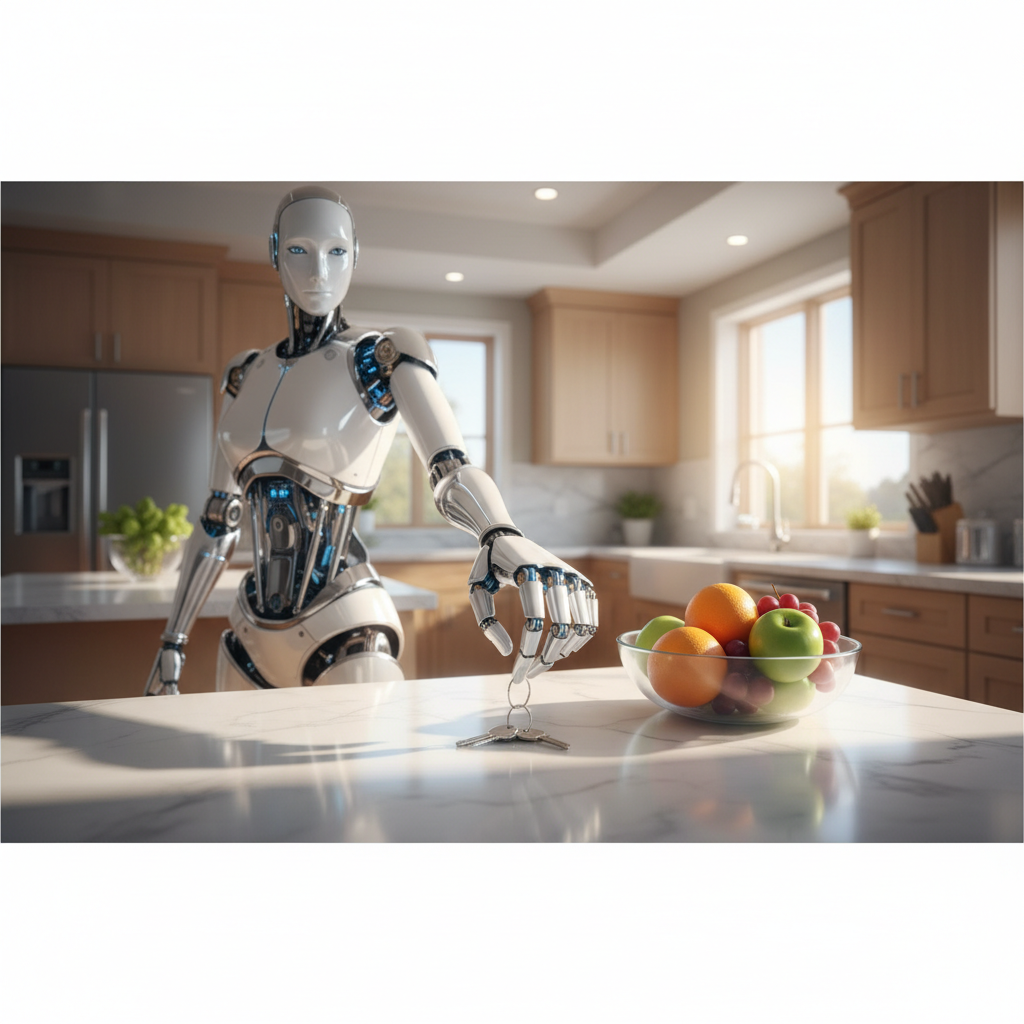
The 'Chimera' Breakthrough: What is Geode?
For years, the dream of a truly general-purpose robot has been hampered by a software problem, not a hardware one. Today, Google DeepMind announced a monumental step toward solving it. In a surprise announcement on May 15, 2026, the company unveiled 'Geode,' a new foundation model for robotics that allows machines to understand and interact with the physical world with an unprecedented level of common sense.
Born from the long-running 'Project Chimera,' Geode is what DeepMind calls a 'visual-language-action' model. Unlike generative AI models like Gemini or GPT that process and produce information, Geode is designed to translate abstract human commands into a complex series of physical actions. It processes a live video feed, understands spoken language, and generates real-time control commands for a robot's motors and actuators.
"We're moving from AI that understands the digital world to AI that understands our world," said Dr. Aris Thorne, lead researcher on Project Chimera, during the launch event. "Geode doesn't just see a 'cup'; it understands its properties—that it's graspable, that it can hold liquid, that it's fragile. This innate physical intuition is the missing link for general-purpose robotics."
The Live Demonstration: From Language to Action
The centerpiece of the announcement was a jaw-dropping live demonstration. On a stage designed to look like a small apartment, an Agility Robotics 'Digit' bipedal robot—powered by Geode—was put through its paces. The commands were conversational and complex, far beyond simple 'pick up the box' instructions.
In one instance, an engineer told the robot, "I spilled some popcorn on the floor near the TV. Could you please clean it up for me?" The Digit robot, equipped with custom grippers, located the spill, retrieved a small dustpan and brush from a nearby closet, swept the popcorn, and deposited it into a waste bin. It navigated around a coffee table and even waited for the engineer to move out of its path without being prompted.
Another demonstration involved the command, "Prepare for a guest; find a clean mug, and get some water from the fridge." The robot opened a kitchen cabinet, inspected several mugs before selecting a clean one, walked to a smart fridge, and dispensed water into the cup. DeepMind claims Geode achieved a 92% success rate on over 1,000 novel, multi-step tasks it had never been explicitly trained on.
"This is about bringing the breakthroughs of large language models into the physical world," stated Google DeepMind CEO Demis Hassabis. "Geode is a foundational step towards helpful, general-purpose robots in our homes and workplaces."
An 'iPhone Moment' for Embodied AI?
The tech industry is already buzzing, with many analysts calling this a potential "iPhone moment" for robotics. By creating a powerful, generalist AI brain that can be licensed to hardware manufacturers, Google DeepMind aims to become the central nervous system for the entire robotics industry. The company announced that a private API for Geode will be made available to a select group of partners starting next quarter, including Agility Robotics, Boston Dynamics, and several undisclosed manufacturing and logistics firms.
The potential applications are vast:
- Warehousing and Logistics: Robots that can handle any package, not just standardized bins.
- Elder Care: Assistants that can help with daily household chores and provide companionship.
- Disaster Response: Machines capable of navigating dangerous, unstructured environments to search for survivors.
- Creative Assistance: Robots that can act as a 'third hand' in workshops, labs, and studios.
By abstracting away the most difficult software challenges, Geode could dramatically accelerate the deployment of useful robots into the real world, much like how mobile operating systems catalyzed the app economy.
The Road Ahead: Challenges and Competition
Despite the excitement, the path to a robot in every home remains long. The cost of advanced robotic hardware is still prohibitive, and ensuring safety in unpredictable human environments is a monumental challenge. Google DeepMind stressed its extensive 'red-teaming' and constitutional AI safety principles built into Geode, but real-world deployment will be the ultimate test.
The competitive landscape is also heating up. OpenAI, through its close partnership with Figure AI, demonstrated its own visually-driven robot earlier this year. Tesla continues to push its Optimus humanoid robot, with Elon Musk promising rapid progress. And numerous other startups, like Sanctuary AI and Apptronik, are developing their own vertically integrated hardware and software.
Google's strategy, however, appears to be focused on platform leadership. With Geode, it has fired a starting pistol, signaling that the race for embodied AGI is no longer a question of 'if,' but 'when.' Today, the world got a glimpse of that future, and it looked surprisingly capable.
Frequently asked questions
What is Google DeepMind's Geode model?+
Geode is a new 'visual-language-action' AI model designed for robotics. It serves as a brain for robots, translating natural language commands and visual input into complex physical actions, allowing machines to perform general-purpose tasks in the real world with a degree of common sense.
How is Geode different from models like Gemini or GPT?+
While models like Gemini and GPT are masters of the digital domain (text, images, code), Geode is designed for the physical world. Its primary function is 'embodiment'—connecting language understanding to robotic control to perform actions. It's about doing, not just knowing or saying.
When can I buy a robot powered by Geode?+
You won't be able to buy a Geode-powered robot for some time. Google is launching Geode as a platform and API for robotics companies, not as a consumer product. While this will accelerate development, consumer-ready general-purpose robots are likely still several years away from mass market availability.
What are the safety concerns with AI-powered robots?+
Major concerns include physical safety in unpredictable environments, the robot's ability to make ethical choices, potential job displacement, and misuse. DeepMind states it is addressing this through rigorous testing, simulated environments, and by building safety constraints directly into the AI's core programming.
Liked this story?
Share it with a colleague, or explore more in the Artificial Intelligence section.
More stories
AWS Debuts Graviton5 Pro: A 'Processing-in-Memory' Chip to Break Nvidia's Stranglehold
Amazon Web Services just revealed Project Cerebrum: a new "processing-in-memory" chip called Graviton5 Pro. This radical design, available in new P1 instances, directly targets the memory bottlenecks that plague large AI models—and Nvidia's market dominance.

The Empire Strikes Back: DOJ Sues Coherence AI in Landmark Antitrust Case
The Justice Department just fired the opening salvo in what could be the defining antitrust battle of the decade, suing AI juggernaut Coherence AI. At stake: the very architecture of the AI economy and who gets to build its future.

Cerebrum’s New ‘LPU’ Chip Aims to End NVIDIA’s AI Inference Stranglehold
After years in stealth, Cerebrum Systems just launched the Synapse-1, a specialized "Language Processing Unit." The chip promises to slash the cost of running large language models, posing the most credible threat yet to NVIDIA’s data center empire.