Google DeepMind's Kinetic-1 AI Gives Robots Unprecedented Dexterity
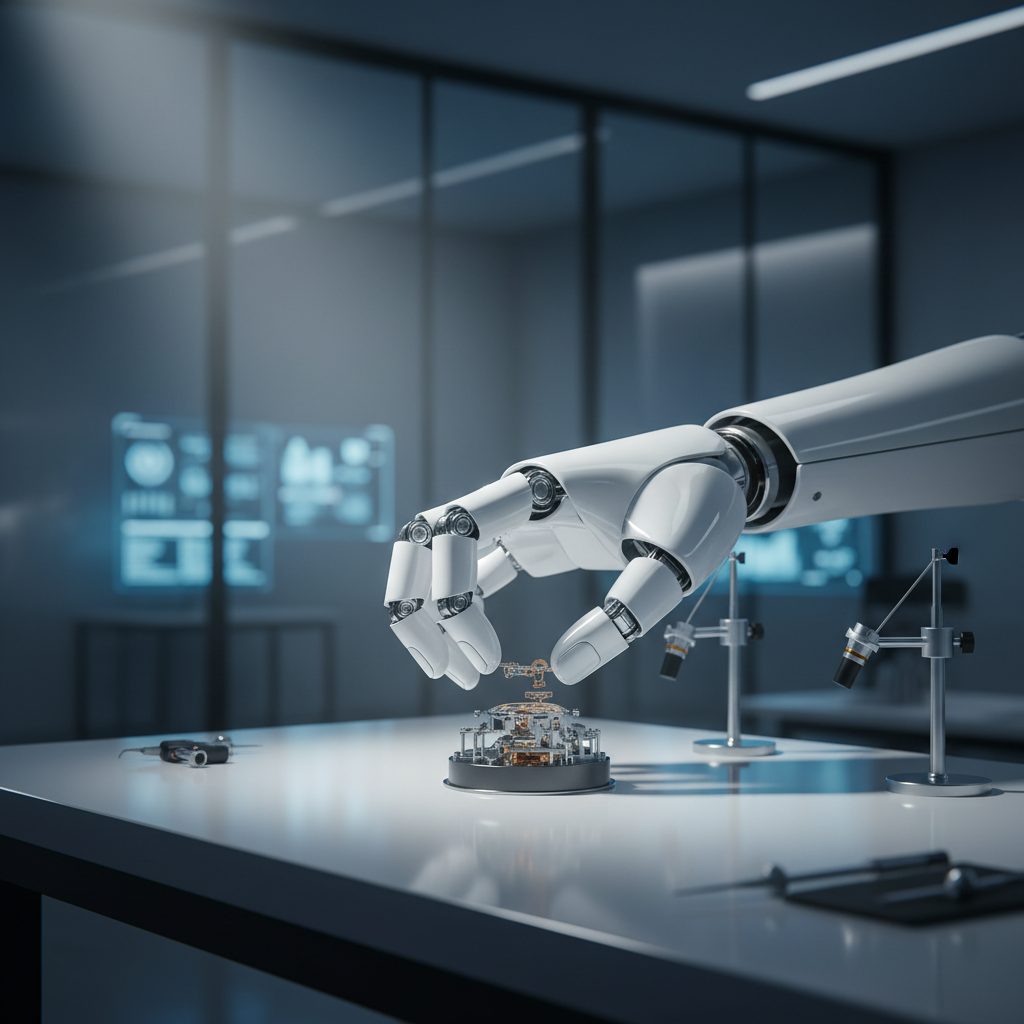
Google DeepMind just pulled back the curtain on Kinetic-1, a groundbreaking AI model for robotics that can interpret vague instructions and execute complex physical tasks, hinting at a new era for autonomous systems in our homes and workplaces.
The Physical World Has a New Language
LONDON, UK – In a move that blurs the line between science fiction and reality, Google DeepMind today unveiled Kinetic-1, a revolutionary AI model designed to give robots the ability to understand and interact with the physical world in a way never before possible. During a live-streamed event from its London headquarters, CEO Demis Hassabis declared that the long-standing challenge of creating general-purpose robots has been “fundamentally cracked.”
Kinetic-1 is a new class of vision-language-action (VLA) model that translates complex, high-level human commands into a series of precise, executable actions for a robot. Where previous generations of robotics AI required painstaking, step-by-step coding for every new task, Kinetic-1 can interpret ambiguous instructions like “clean up this spill” or “prepare a light snack.”
“For decades, the digital and physical worlds have been separated by a vast gulf of complexity,” Hassabis stated during the keynote. “Kinetic-1 is the bridge. It’s an AI that doesn’t just process text and images, but understands physics, cause-and-effect, and human intent in three-dimensional space.”
Behind the Curtain: Chain-of-Motion Reasoning
The core innovation powering Kinetic-1 is a proprietary architecture DeepMind calls “Chain-of-Motion” (CoM) reasoning. Similar to how large language models use chain-of-thought to break down complex questions, CoM allows the AI to deconstruct a physical goal into a logical sequence of smaller, achievable motor actions.
For example, when a user says, “I’m thirsty, get me a glass of water,” Kinetic-1's CoM process generates an internal monologue of steps: 1. Locate a human. 2. Identify a clear path to the kitchen. 3. Open the correct cupboard to find a glass. 4. Grasp the glass with appropriate pressure. 5. Operate the water dispenser. 6. Transport the full glass without spilling. 7. Present it to the human.
This process is fueled by a staggering training dataset comprising over 2 trillion tokens of text and video from the internet, combined with 50 billion data points of real-world robot interactions collected from a fleet of robots at Google’s labs and from strategic partners, including Boston Dynamics. This allows Kinetic-1 to generalize its knowledge across a wide variety of robotic hardware, from multi-jointed arms to legged platforms.
The Demos That Stopped the Show
While the technical details are impressive, it was the live demonstrations that truly showcased the model's capabilities. In one stunning segment, a standard industrial robot arm was given the command, “Make me a sandwich.” The robot proceeded to open a nearby mini-fridge, identify the correct ingredients, use a tool to slice a tomato with surprising deftness, assemble the sandwich, and place it on a plate.
“We specifically chose tasks with multiple stages and a high degree of variability,” explained Dr. Anya Sharma, lead research scientist on the Kinetic-1 project. “The robot isn't following a pre-programmed recipe. It's seeing the ingredients, understanding the goal, and planning its actions in real-time. If we had used ham instead of turkey, it wouldn't have mattered.”
Other demos included a robot folding a pile of laundry with varied items, sorting a complex recycling bin containing ambiguous materials, and even successfully assembling a small piece of flat-pack furniture—a task notoriously difficult for humans, let alone machines.
From Factory Floors to Living Rooms
Google DeepMind has already established pilot programs with several industry partners to bring Kinetic-1 out of the lab. Automotive giant BMW is testing the AI to assist with complex assembly line tasks that still require a human touch, while logistics firm DHL is exploring its use for dynamically sorting and packing irregular parcels in its fulfillment centers.
“The immediate impact will be in structured environments like manufacturing and logistics, where we can see a 30-40% increase in efficiency for certain tasks,” said Hassabis. “But the long-term vision is much broader.”
That vision includes assistive robots for elder care, responsive surgical assistants, and rapid-deployment robots for disaster relief scenarios. The goal, according to DeepMind, is not to replace humans, but to create a new category of “physical AI” that can work collaboratively with people, taking on tasks that are dangerous, repetitive, or physically demanding.
Navigating the Ethical Minefield
The announcement was not without notes of caution. The prospect of highly capable, general-purpose robots raises significant questions about job displacement, safety, and misuse. DeepMind preemptively addressed these concerns, emphasizing their commitment to a “responsible and staged deployment.”
Kinetic-1 includes a sophisticated set of “Coded-in Constraints” to prevent harmful actions, and the models are extensively “red-teamed” by an internal safety group to find and patch potential vulnerabilities. “Safety is not an afterthought; it’s part of the core architecture,” Hassabis insisted. He also stressed the importance of public discourse and regulatory collaboration to build a robust framework for this new technology.
Today’s announcement feels like a watershed moment. Kinetic-1 is not just an incremental improvement; it represents a fundamental shift in our relationship with machines. The era of the general-purpose robot may have just begun, bringing with it a world of possibilities and a host of new challenges that we must navigate together.
Frequently asked questions
How is Kinetic-1 different from previous robotics AI?+
Kinetic-1 moves beyond pre-programmed instructions. It uses a 'Chain-of-Motion' reasoning to understand high-level, ambiguous commands and devise its own action plan in real-time. This allows it to generalize tasks and adapt to new situations, much like a human would.
What kind of robots can use Kinetic-1?+
Kinetic-1 is designed to be hardware-agnostic. While demos featured industrial arms and legged robots, its foundational model can be adapted to control a wide variety of robotic platforms, provided they have the necessary sensors and manipulators. The key is in the AI brain, not the specific robotic body.
When will we see products powered by Kinetic-1?+
Pilot programs are already underway in industrial settings like manufacturing and logistics, with wider commercial availability expected within 18-24 months. Consumer-facing applications, such as home assistants, are still further out, likely in the 5-10 year timeframe, pending cost reduction and further safety validation.
What are the safety concerns with such advanced robots?+
Primary concerns include ensuring the robot cannot be instructed to perform harmful actions, preventing accidental damage to property or people, and securing the system against malicious hacking. Google DeepMind emphasizes layered safety protocols, including coded constraints, rigorous testing, and physical emergency stops on the hardware itself.
Liked this story?
Share it with a colleague, or explore more in the Artificial Intelligence section.
More stories
AWS Debuts Graviton5 Pro: A 'Processing-in-Memory' Chip to Break Nvidia's Stranglehold
Amazon Web Services just revealed Project Cerebrum: a new "processing-in-memory" chip called Graviton5 Pro. This radical design, available in new P1 instances, directly targets the memory bottlenecks that plague large AI models—and Nvidia's market dominance.

The Empire Strikes Back: DOJ Sues Coherence AI in Landmark Antitrust Case
The Justice Department just fired the opening salvo in what could be the defining antitrust battle of the decade, suing AI juggernaut Coherence AI. At stake: the very architecture of the AI economy and who gets to build its future.

Cerebrum’s New ‘LPU’ Chip Aims to End NVIDIA’s AI Inference Stranglehold
After years in stealth, Cerebrum Systems just launched the Synapse-1, a specialized "Language Processing Unit." The chip promises to slash the cost of running large language models, posing the most credible threat yet to NVIDIA’s data center empire.