Kinetic Dynamics' $75K Humanoid Robot 'Steward' is Here to Upend Logistics
For years, general-purpose humanoid robots were a lab curiosity. As of today, Kinetic Dynamics has made them a commercial reality, launching its KD-8 "Steward" for $75,000. The first units are already heading to Amazon and Walmart warehouses, sparking an automation gold rush.
The Robot is Clocking In
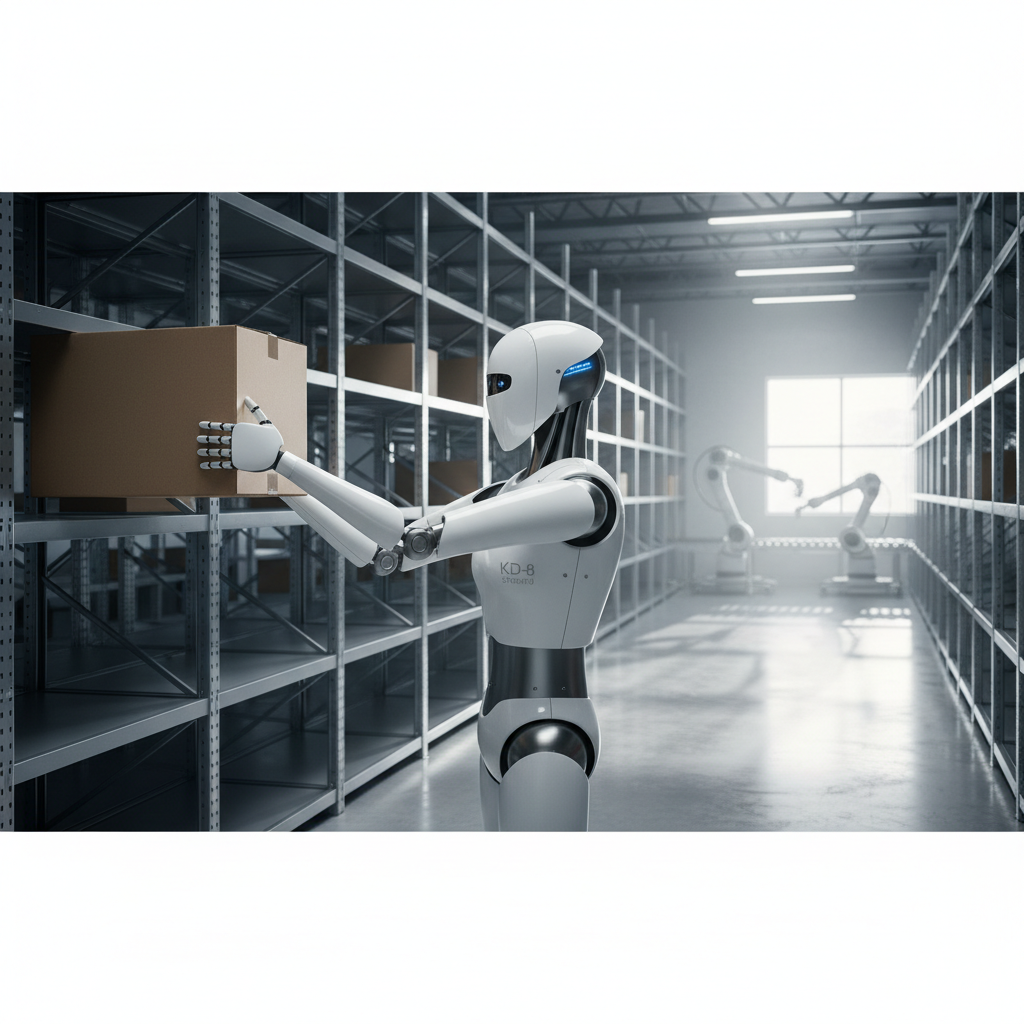
The line between science fiction and the supply chain has officially been erased. This morning, robotics firm Kinetic Dynamics announced the commercial launch of its flagship product: the KD-8 “Steward,” a fully autonomous, general-purpose humanoid robot. Priced at $75,000 per unit, with a Robotics-as-a-Service (RaaS) option available, the Steward is not a research prototype. It’s a commercial product aimed squarely at the multi-trillion dollar logistics industry, and its first customers are the biggest players in the game: Amazon and Walmart. The shift from specialized, caged robotic arms to bipedal, adaptable robots walking the warehouse floor marks a pivotal moment in automation—one with profound implications for labor, efficiency, and the very nature of physical work.
A New Era for Embodied AI
For the past decade, warehouse automation has been dominated by Automated Guided Vehicles (AGVs) like the Kiva bots that shuffle shelves, or fixed robotic arms that perform a single, repetitive task. The Steward is a fundamentally different proposition. Standing 5'9" and weighing 165 pounds, it navigates complex, human-centric environments on two legs. It can walk, sidestep, crouch, and carry payloads up to 55 pounds. Its primary function is to bridge the gap between existing automation and the final, manual steps of logistics: picking a specific item from a varied shelf, placing it in a bin, and transporting it across a dynamic facility.
Unlike its predecessors, the Steward isn’t confined to a specific track or pre-programmed path. It uses a suite of LiDAR, depth cameras, and IMUs to perceive its environment in 3D, dynamically planning its path around unexpected obstacles, including human coworkers. Its five-fingered hands, equipped with tactile sensors, are nimble enough to handle a wide range of objects, from heavy boxes to delicate produce, without requiring custom end-effectors for each task. This is the promise of “embodied AI”—an intelligence that can perceive, reason about, and physically act upon the world.
The $75,000 Question: Is It Worth It?
The sticker price is steep, but the economic calculation for Kinetic’s target customers is brutally simple. A single Steward unit costs roughly the equivalent of one year's fully-loaded salary for a human warehouse worker in many parts of the United States. But a robot doesn’t take breaks, get sick, or work in shifts. Operating 22 hours a day (with 2 hours for automated charging), a single Steward can perform the work of nearly three human employees over a 24-hour cycle.
“Kinetic isn't just selling a robot; they're selling an operational expenditure that directly competes with labor costs,” says Dr. Anya Sharma, lead robotics analyst at Gartner. “At this price point, the ROI calculation for a 24/7 fulfillment center becomes compellingly short, likely under 18 months. The RaaS model, which we estimate will be around $8-$10 per hour, makes adoption even more frictionless.”
The conversation is no longer about whether humanoid robots will take over warehouses, but how quickly they will do it.
Kinetic is betting that a wave of corporate capital, desperate to insulate supply chains from labor shortages and rising wages, is about to be unlocked. Early orders from Amazon (rumored to be 1,000 units) and Walmart (rumored 750 units) for deployment in their next-generation fulfillment centers suggest that bet is paying off.
Under the Hood: Fusing Vision, Language, and Action
The Steward’s physical dexterity is powered by what Kinetic calls “Kinetic Brain 2.0,” a new class of foundation model known as a Vision-Language-Action (VLA) model. This onboard AI allows the robot to understand and execute complex, natural-language commands. A warehouse manager can issue a directive like, “Take all items with SKU 85B-1 from aisle 7 and move them to packing station 3.” The Steward parses this command, uses its cameras to visually identify the correct items, plans a path, and executes the task.
This is a quantum leap beyond the rigid programming of past industrial robots. The AI was trained on a massive dataset comprising petabytes of simulated physics interactions, video feeds from existing warehouses, and teleoperation data where human operators guided robots through complex tasks. A key innovation is a “negative learning” paradigm, where the AI is specifically trained on what not to do—don't block a fire exit, don't pick up a damaged box, don't move too quickly around people—to ensure safe operation.
The physical hardware is equally impressive, featuring custom-designed proprioceptive actuators that allow the robot to feel its own movement and force application, preventing it from crushing a fragile item or damaging equipment. This combination of advanced software and bespoke hardware is what allows the Steward to operate in messy, real-world environments.
The Elephant in the Warehouse: Labor Disruption
Kinetic Dynamics’ press materials are filled with anodyne phrases about “human-robot collaboration” and “empowering associates.” During today's launch event, CEO Marcus Thorne was quick to frame the Steward as a partner, not a replacement. “Steward is designed to work alongside people, handling the most repetitive, strenuous, and dangerous tasks,” Thorne stated. “This frees up our human partners for roles requiring complex problem-solving, oversight, and equipment maintenance.”
Labor advocates are less sanguine. Unions representing logistics workers have already decried the launch as a major threat to jobs. The tasks Steward is designed for—picking, packing, sorting, and hauling—are the bread and butter of warehouse employment. While new roles in robot maintenance and oversight will be created, it's unlikely they will offset the number of roles displaced, particularly in the short term. The debate over Universal Basic Income (UBI) and reskilling initiatives just gained a 165-pound, bipedal dose of urgency.
What's Next: From Warehouse to Main Street?
Kinetic has secured a powerful first-mover advantage in the nascent humanoid robotics market. The company plans to ramp up production to tens of thousands of units per year by 2028. Their roadmap reportedly includes software updates that will expand the Steward's skillset to light manufacturing, retail inventory management, and even janitorial services.
The path forward is not without challenges. Competitors, from established players like Boston Dynamics to well-funded startups and even tech giants like Tesla with its Optimus project, are close behind. Furthermore, safety regulations for autonomous robots operating alongside humans are still in their infancy, and a single high-profile incident could set the entire industry back years. Public acceptance also remains a significant hurdle.
For now, though, the KD-8 Steward is a reality. It's a marvel of engineering and artificial intelligence, and a testament to human ingenuity. But as the first units are unboxed in the vast cathedrals of modern commerce, they bring with them a set of profound questions. We have successfully taught a machine to walk, see, and work like a person. Now we must decide how our society will adapt to a world where we are no longer the only ones on the factory floor.
Frequently asked questions
Is the KD-8 Steward autonomous or remote-controlled?+
It's primarily autonomous, using its onboard AI to interpret high-level commands and navigate dynamic environments. However, it also includes a 'human-in-the-loop' teleoperation mode. This allows a remote human operator to take control when the robot encounters a completely novel situation it can't solve, simultaneously providing valuable training data to improve the entire fleet's capabilities.
How does the Steward compare to Tesla's Optimus robot?+
While both are humanoid robots, their strategies differ significantly. Tesla's Optimus is, for now, an R&D project focused on deployment within Tesla's own manufacturing facilities. Kinetic Dynamics' Steward is a commercially available product *today*, targeting the logistics sector with a clear B2B sales model, launch partners like Amazon and Walmart, and a defined price point.
What are the main safety features of the robot?+
The Steward is built with a multi-layered safety architecture. This includes a 360-degree sensor suite for real-time obstacle avoidance, force-torque sensors in every joint to precisely control interaction forces, and a dedicated, safety-rated computer that can trigger an immediate emergency stop. It's designed for collaborative work, but initial deployments will be in zones with controlled human access as an added precaution.
Can the robot be used for tasks other than logistics?+
Currently, its hardware and AI are highly optimized for warehouse tasks like picking, carrying, and sorting. Kinetic's roadmap includes future software modules to unlock new capabilities for light manufacturing, retail stock-keeping, and even janitorial work. However, these are future expansions. Today, the KD-8 Steward is a logistics specialist.
What kind of AI model does the robot use?+
It runs on a proprietary AI system called 'Kinetic Brain 2.0,' which is a type of Vision-Language-Action (VLA) model. This allows it to understand natural language instructions and translate them into physical actions in the real world. It was trained on a vast dataset of simulations and real-world videos, and the entire fleet learns collectively, with improvements from one robot pushed to all others via software updates.
Liked this story?
Share it with a colleague, or explore more in the Artificial Intelligence section.
More stories
AWS Debuts Graviton5 Pro: A 'Processing-in-Memory' Chip to Break Nvidia's Stranglehold
Amazon Web Services just revealed Project Cerebrum: a new "processing-in-memory" chip called Graviton5 Pro. This radical design, available in new P1 instances, directly targets the memory bottlenecks that plague large AI models—and Nvidia's market dominance.

The Empire Strikes Back: DOJ Sues Coherence AI in Landmark Antitrust Case
The Justice Department just fired the opening salvo in what could be the defining antitrust battle of the decade, suing AI juggernaut Coherence AI. At stake: the very architecture of the AI economy and who gets to build its future.
Cerebrum’s New ‘LPU’ Chip Aims to End NVIDIA’s AI Inference Stranglehold
After years in stealth, Cerebrum Systems just launched the Synapse-1, a specialized "Language Processing Unit." The chip promises to slash the cost of running large language models, posing the most credible threat yet to NVIDIA’s data center empire.