The Day Encryption Died: 'Shorfall' Attack Confirms Quantum Threat
The cybersecurity community's 'Y2Q' moment has arrived years ahead of schedule. A sophisticated attack dubbed 'Shorfall' has reportedly used a quantum computer to break RSA-2048, rendering a cornerstone of modern digital security obsolete overnight.
The Unthinkable Breach
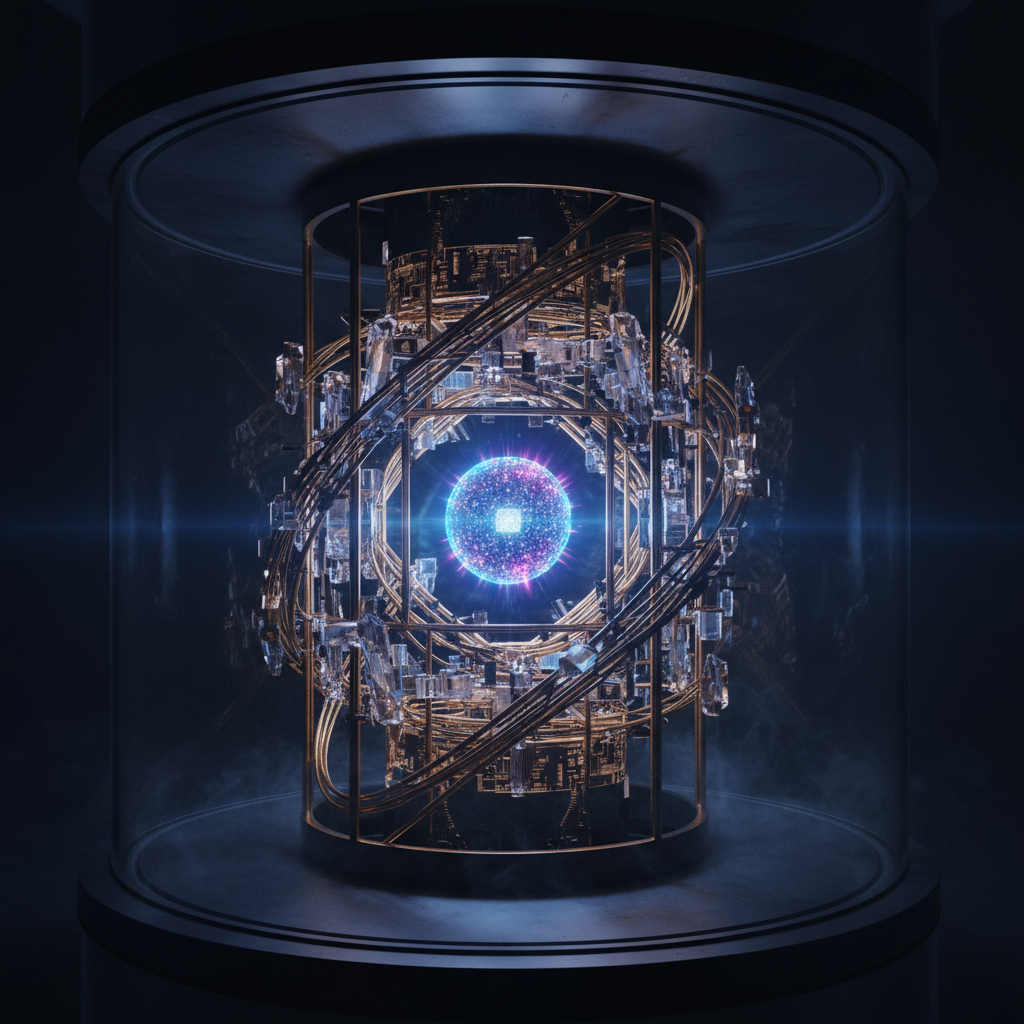
The message arrived not with a bang, but with the quiet, chilling precision of a state secret being laid bare. Early Tuesday morning, August 25th, 2026, the global financial system shuddered as Deutsche Bank confirmed a catastrophic data breach. But this wasn't another story of a stolen password or a phishing-baited employee. Forensics firm Mandiant, in an emergency threat intelligence report, confirmed the unthinkable: the attackers hadn't broken in, they had broken math. The bank’s encrypted data archives, protected by the industry-standard RSA-2048 algorithm, were cracked wide open. The culprit was not a clever piece of malware, but a fault-tolerant quantum computer. The cybersecurity world has a new name for its apocalypse: Shorfall.
What is 'Shorfall'?
The term, coined in Mandiant's report and already rocketing across intelligence circles, is a grim portmanteau of Shor's Algorithm—the theoretical quantum algorithm for factoring large numbers—and the fallout from its successful implementation. For decades, Peter Shor's 1994 paper was a spectre haunting cryptography; a theoretical monster that could one day devour the public-key encryption that underpins nearly all digital security. Today, that monster is real.
According to Mandiant's preliminary analysis, the attack was perpetrated by a state-sponsored group they've designated 'Cerberus Kilo,' believed to be an evolution of China's most advanced cyber-espionage units. The group targeted a massive, multi-petabyte archive of Deutsche Bank's transaction records and client data dating back over a decade. This data, encrypted and stored offline, was considered perfectly safe. It was a prime example of a 'harvest now, decrypt later' target.
"The attackers didn't need to bypass firewalls or trick employees," the report states. "They simply took the encrypted data, which was exfiltrated in a low-and-slow breach over 18 months ago, and applied a quantum computer powerful enough to derive the private keys. From a purely cryptographic standpoint, it's a nightmare scenario." The machine used is estimated to be a stable, error-corrected device exceeding 10,000 logical qubits—a milestone experts believed was still five to seven years away.
A 'Cryptopocalypse' Years in the Making
The warnings have been blaring for years. Cryptographers, national security agencies, and standards bodies like the National Institute of Standards and Technology (NIST) have long prophesied a 'Y2Q' (Year to Quantum) event that would necessitate a global migration to new forms of encryption. The race was on to develop and standardize Post-Quantum Cryptography (PQC)—algorithms resistant to attack from both classical and quantum computers.
The transition to post-quantum cryptography is no longer a theoretical exercise or a future-proofing measure. It is now an emergency remediation for a security paradigm that has already been broken.
In 2024, NIST finalized its first suite of PQC standards, including CRYSTALS-Kyber for key exchange and CRYSTALS-Dilithium for digital signatures. The world had its tools. The problem was implementation. The transition is a staggeringly complex and expensive undertaking, requiring every piece of software, every server, and every hardware security module on the planet to be updated. Faced with immense cost and no immediate threat, most of the private sector dragged its feet.
"We've been racing against a clock without knowing what time it was set to," says Dr. Lily Chen, a mathematician in NIST's Computer Security Division and a key figure in the PQC project. "Today, the alarm went off. The 'harvest now, decrypt later' strategy, long discussed as a hypothetical, has just been proven devastatingly effective. Any sensitive data encrypted with legacy algorithms in the past decade is now potentially compromised."
The Technical Hurdle That Just Fell
RSA-2048's security relies on a simple premise: it's easy to multiply two large prime numbers together, but computationally impossible for a classical computer to take the resulting product and figure out the original prime factors. A 2048-bit number is so astronomically large that a conventional supercomputer would take billions of years to factor it. It's a one-way mathematical door.
Shor's Algorithm, when run on a sufficiently powerful quantum computer, walks right through that door. By leveraging principles like superposition and entanglement, it can find the prime factors of a 2048-bit number in a matter of hours, not millennia. The primary obstacle was never the math, but the physics and engineering: building a quantum computer with enough stable, high-fidelity 'logical' qubits to run the algorithm without collapsing into a noisy mess of errors.
The success of Shorfall implies that 'Cerberus Kilo,' backed by massive state investment, has not only built a machine with tens of thousands of physical qubits but has also mastered the fiendishly complex quantum error correction codes needed to distill them into the ~10,000 logical qubits required for the attack. This leapfrogs publicly acknowledged progress from companies like Google, IBM, and Quantinuum by a significant margin.
Winners, Losers, and the New Arms Race
The immediate losers are legion. Deutsche Bank is just the first domino. Any government, corporation, or individual with long-term secrets—from military intelligence and intellectual property to financial records and healthcare data—protected by RSA or similar schemes is now in a state of crisis. The value of data exfiltrated over the past decade has suddenly skyrocketed, as it can now be unlocked. The stock market is already reflecting this reality, with financial and tech stocks tumbling while cybersecurity firms specializing in PQC are seeing unprecedented spikes.
The winners? First and foremost, the nation-state behind 'Cerberus Kilo,' which now holds the keys to an untold quantity of the world's secrets. Secondly, the burgeoning PQC industry. Companies like SandboxAQ, PQShield, and the consulting arms of major tech firms are about to become very, very busy. Their sales pitch just went from "Prepare for the future" to "Fix the present, right now."
This event signals the true beginning of a quantum-cyber arms race. Having a cryptographically relevant quantum computer is now a matter of national survival, on par with having a nuclear deterrent. Expect governments to pour tens of billions more into their own quantum programs, both for offensive and defensive capabilities. Secrecy, already high in the quantum R&D world, will now become absolute.
Shorfall is not the end of encryption. It is the violent, sudden end of an era. The transition to a post-quantum world will be a chaotic, brutally expensive, and multi-year scramble. For years, we treated the quantum threat as a distant storm on the horizon. Today, the storm made landfall, and we are just beginning to survey the wreckage.
Frequently asked questions
Is my personal data (email, banking) immediately at risk from Shorfall?+
The immediate threat is to large, archived datasets encrypted years ago, like the one in the Shorfall incident. Everyday connections to your bank or email use session-based keys that are harder to attack in real-time. However, the precedent is terrifying. Service providers will now race to upgrade their systems, but the era of assuming your encrypted data is safe forever is definitively over.
What is Post-Quantum Cryptography (PQC) and is it ready?+
PQC refers to new encryption algorithms designed to be secure against both classical and quantum computers. The underlying math is based on problems that even quantum machines find difficult. Standardized algorithms from NIST, like Kyber and Dilithium, are 'ready' in the sense that the specifications exist. However, global implementation is a massive undertaking that, for most organizations, is only just beginning.
Why didn't everyone switch to PQC sooner?+
The transition is immensely complex, expensive, and can cause system incompatibilities. Many organizations adopted a 'wait-and-see' approach, underestimating the speed of quantum hardware development. Until the NIST standards were finalized in 2024, there was also uncertainty about which algorithms to bet on. Shorfall proves this cautious approach was a catastrophic miscalculation.
What industries are most vulnerable right now?+
Financial services, government and defense, healthcare, and critical infrastructure are the most exposed due to the high value and long-term sensitivity of their stored data. Any sector with valuable intellectual property or state secrets that were encrypted with legacy public-key algorithms is now in a state of emergency. The value of historical data breaches just increased exponentially.
Can the 'Shorfall' quantum attack actually be proven?+
Direct proof is nearly impossible, as it would require access to the attacker's classified quantum computer. However, cybersecurity experts infer the cause through forensic analysis and elimination. When a vast trove of data, protected by demonstrably strong classical encryption, is compromised without any other trace of intrusion (like stolen keys or system vulnerabilities), cryptographic failure becomes the only logical, albeit terrifying, conclusion.
Liked this story?
Share it with a colleague, or explore more in the Cybersecurity section.
More stories

'GhostThread' Exploit Paralyzes Seoul and Singapore's Smart Grids
A novel zero-day exploit, dubbed 'GhostThread,' has brought two of the world's most advanced smart cities to a standstill. The attack on the ubiquitous QuantumMesh protocol reveals the catastrophic fragility at the heart of our connected future.
Rust’s Fortress Breached: Inside the ‘Ferrous Maelstrom’ Supply Chain Attack
Rust, the language prized for its security, is facing an ecosystem-level crisis. A sophisticated, state-sponsored attack on its central package registry has left thousands of companies scrambling to discover if their software is compromised. This is what happened.
The Web's Encryption is Broken: Inside QUIC-Sandman, the Bug Shaking the Internet
A newly disclosed vulnerability, QUIC-Sandman, allows attackers to bypass encryption protections in the internet's foundational QUIC protocol. We are now in a race to patch the web before widespread exploitation begins. The very trust model of our connected world is at risk.